
Every capital program owner is fielding the same pitch right now: some vendor is claiming to have an AI tool that will fix your document chaos, catch your compliance gaps, and automate the processes you don’t like to do manually. Some of these products add real value, but many fall apart the moment you begin to explore how the tool would actually work inside your organization.
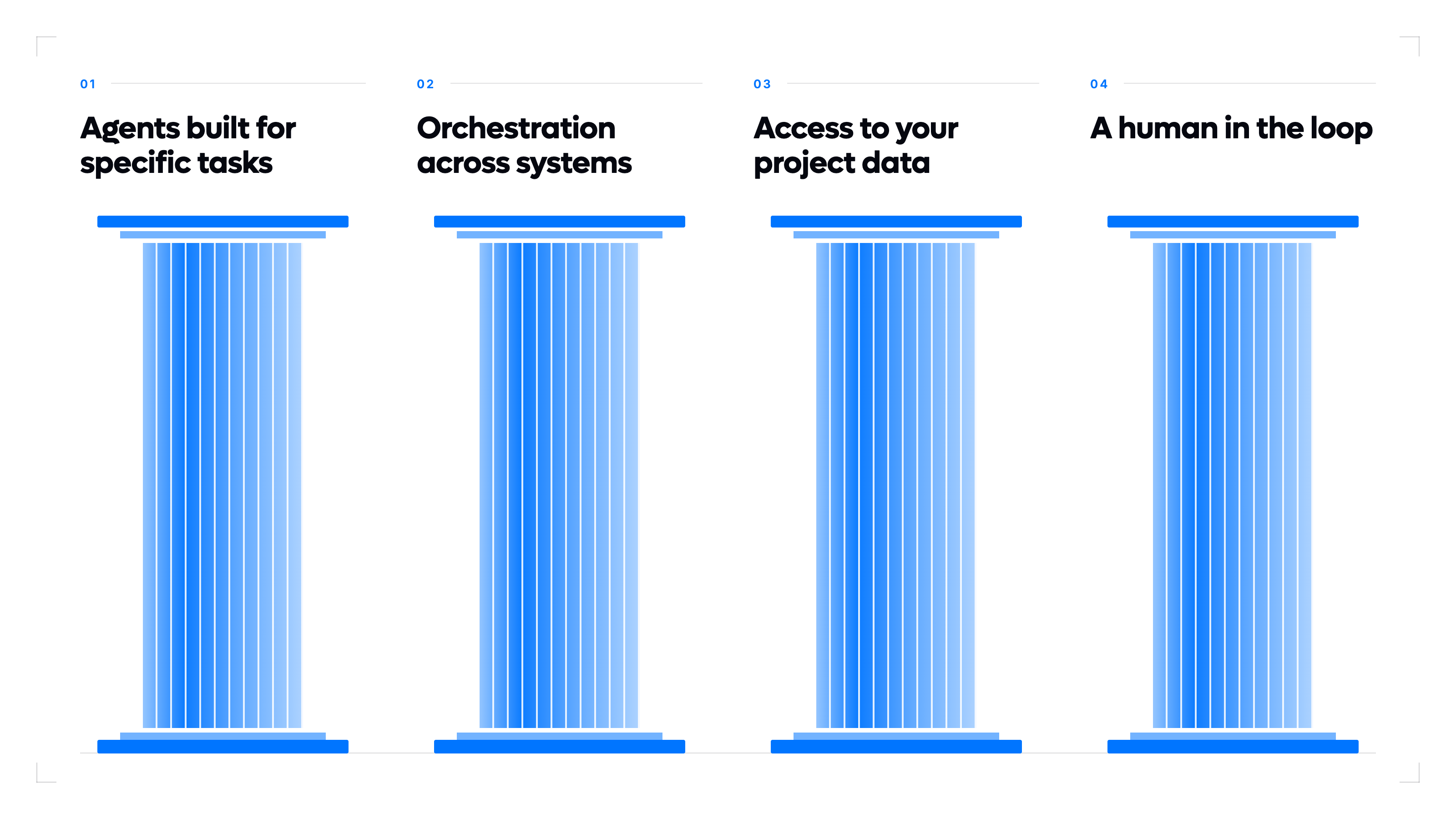
In our recent webinar, Foundations of AI for Capital Programs, Gryps Co-Founder & CTO Amir Tasbihi shared a useful framework for cutting through the noise: four elements he believes every successful agentic AI deployment should have. If the AI tool you’re evaluating is missing one or more of these, you might want to think twice about whether it will work in practice.
Pillar 1: Agents built for your specific work
The first pillar is having agents built for the specific task at hand, not a generic, off-the-shelf agent. Every industry and every organization has its own unique way of doing things, and when an agent can’t execute your specific processes it leads to inaccuracy, lack of trust and adoption, and eventually the tool being shelved altogether because it’s seen as unreliable.
Instead, look for tools that already have a built-in understanding of your specific industry, and are able to adapt to how your organization already works. It’s easy to spin up an impressive proof of concept, but much more complicated to build something that follows your unique processes instead of forcing you to change them.
Pillar 2: Orchestration across your systems
The second pillar is orchestration: the ability to take actions across the different systems your team already relies on. No vendor gets to walk into an organization and say, "drop these three tools you use today so my product will work." Instead, reliable AI products are built to work with your existing systems with minimal disruption. In the construction industry, that means connecting to legacy, sometimes clunky PMISs and other systems, using APIs where available but having other solutions such as robotic process automation (RPA) where needed.
Without the ability to work across your existing systems, AI agents will never be able to automate the robust processes that will drive real value. Construction data is fragmented across a variety of tools, and that’s not changing any time soon. Look for AI that’s built to thrive in this reality, not wish it away.
Pillar 3: Access to your organization's history and context
The third pillar is what we refer to as an intelligence layer: the agent’s ability to know what has happened in your organization over time. To automate complex processes, agents need to know what is happening in your projects, what processes are in place, who you’re working with, etc. Without that institutional memory, the agent is starting from zero every time, and relying on you to manually give it all the context it needs. That’s not efficiency, it’s extra work.
Solving this problem is closely related to the orchestration challenge. The companies building practical AI solutions aren’t just connecting to your existing systems to enable workflows; they’re also pulling together all the data and documents you have scattered across those systems and normalizing them into a single context layer. This may not sound as exciting as launching agents, but without it many agents wouldn’t be worth the trouble.
Pillar 4: A human in the loop
The fourth and final pillar is a human-in-the-loop process. Even as agents take on more work, there needs to be a way for your team to review the output. Tet review step builds trust in the agents over time, and trust ultimately leads to a successful long-term adoption rather than another scrapped pilot. Automation is important, but so are visibility and control.
Getting started
Evaluating AI solutions for your organization doesn’t have to be that complicated. Don’t try to do everything at once. Instead identify the highest-impact, most painful processes in your organization, get one agent working well, and expand from there. To make this process even easier, work with a technology partner that already understands the unique challenges and processes you have as an owner.
None of these four pillars work in isolation. Well-built agents with no orchestration just create another data silo. Organizational knowledge without human review erodes trust. But when all four of these elements come together, you have an AI solution that’s ready to make the jump from an impressive demo to a tool your team relies on every day.
Want to learn more about how owners can make informed AI buying decisions? Watch the full webinar here.